Sunday, March 26, 2017
12. The Throwback Special
One of the hardest things about reading a new book every week is finding what to read next. It should be easy, right? I mean, there are literally millions of books in the world. Everyone has an opinion about what to read next. Maybe it's because you guys are actually reading this blog and taking my suggestions; for whatever reason, I feel this pressure not to waste my time or yours and get it right.
I would have never picked up The Throwback Special if I hadn't heard about it on NPR. It just wouldn't have caught my eye in a bookstore and, as you're about to hear, the premise is a little unusual. But, on a podcast about the best books of 2016, two different women named this among their favorites for the last year. I can totally see why.
That unusual premise? For 22 years, a group of now-middle aged men gets together in a shabby hotel for one simple purpose: to reenact one of the most gruesome plays in NFL history. In 1985, Redskins QB Joe Theismann suffered a career-ending injury when Lawrence Taylor broke his leg on Monday Night Football. Don't take my word for it. In this YouTube era, you can watch it happen.
You may be asking yourself, how the hell did they make a whole book out of that? Turns out, the book is about a whole lot more than that. The actual acting out of the play takes less than five minutes in real time and nothing more than a few pages in the book. But, it sets up a fascinating dynamic between these men, this ritual and the fight to hang onto something normal (ish) from their youth.
I had no problem relating to the concept of this. My husband is part of an insanely close group of friends who I could totally see doing this (though their ritual might be something more like the WSU Cougars heartbreaking loss in the 1998 Rose Bowl.) I've heard enough dudes in my life remember exact plays from high school games that happened 20+ years ago. I totally understand the concept of sports as bonding.
For these guys, the ritual brings them together, but their connection comes from complaining about their back pain, misunderstanding their kids, watching their marriages fall apart. It sounds maudlin, but it doesn't come across that way in the book. It's just the reality of their lives. You see how different they all are - you wonder how they ever came together in the first place. You see they're more attached to the idea that they have to attend this annual gathering than they are to the friendships they've no doubt formed over the years. For the one weekend a year, they simply exist in this space. And when life takes you to unexpected places, maybe that small thread of tradition is all that really holds friendships together.
The whole set up of the weekend is subtly hilarious. They wear full pads, passed from one guy to another each year. They hold a lottery to decide who will portray each player (L.T. is always chosen first; no one wants to be Theismann.) Position players bunk together. Theismann sleeps alone.
The book itself is a fast read. It's complex in its simplicity. If you're an old-school football fan, you'll love it. If you've never watched a down of football in your life and have no idea what a flea-flicker is, there's still something in it for you.
Before I go, a confession: I broke tradition. I started book 13 before I wrote this review of 12. And, it's SO GOOD already, I'm already moved on and invested. I hope I didn't short change this review because of that. There's a reason this book was a National Book Award Finalist. That's enough to give it a shot.
Saturday, March 18, 2017
11. Girl With the Lower Back Tattoo
I needed a breath, guys.
After reading Lincoln in the Bardo, I couldn't read another work of fiction right away. That book was too incredible, too groundbreaking, too amazing to just dive headlong into another novel. Anything I read after that would seem like Dr. Suess in comparison. I needed to go another direction.
My path led me to Amy Schumer.
(More specifically, my path led me to my neighborhood public library. I needed to prove to my husband I wasn't planning to buy 52 books this year. Checking out a book was nostalgic, easy and FREE. One thing, though: what happened to the Dewey Decimal System? Gone. That's a rant post for another day.)
Here's the best thing I can tell you about this book. If you hate Amy Schumer, you won't like the book. It's that simple. And, whether or not you like her is definitely a matter of taste. I happen to love her. This book made me love her even more.
I've read a lot of books by comedians and the format is essentially the same; you'll read essays about their lives, how they got where they are, random observations, etc. This is definitely that kind of book. It's a quick, easy read and you hear it in her voice. I love that she uses transitions like "Anywhoozle", which I like to drop on the regular. Does it make me sound smart? No. That's not the point. It's accessible, though, and relatable.
You won't be surprised know that an Amy Schumer book starts with what he calls "An Open Letter to my Vagina." If you're offended by that word, you won't like this book. Also, if you're offended by that word, what's your problem?)
The book, though, is not a collection of sexual and shocking stories. It goes so much deeper than that. She talks about her losing her virginity in an act of non-consensual sex - and, how it's far more common than most people would like to admit. She talks about her parents' imperfections and infidelity. She talks about the inane international press tours where every journalist thinks they're smart and compelling by repeatedly asking, "What's it like to be a woman in Hollywood?" She'll deliver something serious, then follow up with a comedic palate cleanser. She shows that she's more than a comedian; she shows she has layers, just like everyone else.
Schumer writes a lot about expectations. What society expects from her as a woman in comedy - what society expects of all women, really. And, addresses critics who say "Stick to comedy" - as if we're all supposed to be defined only by our jobs and what people expect from us.
She goes deepest, though, when she talks about an event that changed her life. She goes into detail about the shooting at a theater showing of her movie Trainwreck. A mentally disturbed man who shouldn't have been able to access a gun opened fire and killed two women. That opened Schumer's eyes to the legislative loopholes that allow people like this to get guns and kill innocent people. She goes as far as to save several pages at the end of the book to show people how they can get involved in preventing gun violence; she also lists the names of members of Congress who have taken money from and been influenced by the gun lobby.
Despite what her critics say, she doesn't blame guns. She blames the gun lobby. It's not the same thing. And, she pays tribute repeatedly to the women whose lives were lost just because they wanted to go watch her movie and laugh and escape. She even dedicates the book to them.
What resonates most are those completely relatable and, often uniquely female, experiences. Our relationships with our mothers, our relationships with our friends, our relationships with our own bodies and balancing that with what society expects us to be. I'm all in this with her. She talks about sex in her comedy, so people assume she's a "slut." In the book, she describes having a single one-night stand in her life.
I feel like Amy and I could be friends. Her book shows that delicate balance between being self-deprecating and strong as hell. From doubting herself to believing she's beautiful. And, getting to the point where she does not give a f*ck what you think of her, despite relying on fans and fan support to make a living.
"I'm a level-one introvert who headlined Madison Square Garden... I'm the overnight success who's worked her ass off every single moment for more than a decade. I used to shoplift the kind of clothing that people now request I wear to give them free publicity. I'm the SLUT or SKANK who's only had one one-night stand. I'm a 'plus-sized' 6 on a good day and a medium-size 10 on an even better day... I'm a strong, grown-ass woman who's been physically, sexually and emotionally abused by men and women I trusted and cared about. I've broken hearts and had mine broken, too."
Hell. Yes.
I liked her before; I respect the hell out of her now.
Thursday, March 9, 2017
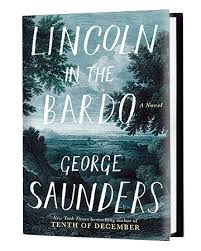
10. Lincoln in the Bardo
Son of a bitch. That was a book.
You're going to need to pardon my enthusiasm here, but I'm going to go all "9th grade crush" on this thing. This is, without question, one of the best books I've read in years. It's also the kind of book that punches you right in the face on page one, then keeps you on the ropes for another 343.
It will also be almost impossible to explain.
First off, I'm going to admit something. I didn't know what a bardo was. I'm not a moron. I mean, I have an English degree. From a real college! But, I had never heard the word before. Because I had a basic idea of the premise of the book (stand by for that in just a second), I thought a bardo was a cemetery. It still would have made sense. But, it made so much more sense when I stopped about a quarter of the way through and Googled the word.
bar·do
ˈbärdō/
noun
- (in Tibetan Buddhism) a state of existence between death and rebirth, varying in length according to a person's conduct in life and manner of, or age at, death.
Got it? Now you're way ahead of where I was when I started. That's a free tip just for reading this blog!
So, Lincoln in the Bardo refers to Abe Lincoln and that state between death and rebirth. It's based on the historical note that, after his son Willie died, Lincoln would visit the cemetery alone, late at night, to visit his young boy. It's a heartbreaking footnote to history.
Before I explain more, you need to enter that state known as the willing suspension of disbelief. This isn't a memoir. It's not a biography. It's fiction. Got it? You're going to need to get in that head space.
The story of Lincoln's macabre nocturnal visit is told through other ghosts in the bardo. They're a motley cast of characters. Their diction is unusual, to say the least. The author paints a vivid, yet disturbing and distorted picture of each. And, the story volleys back and forth between them in abrupt paragraphs. It's wild. At first, it's really hard to read. Then, it sucks you into their world and you're off and running.
Those chapters alternate with snippets of historical information about the night young Willie died. Some are real tales, some are manufactured. Either way, they paint the "real life" picture of how Willie ended up in that crypt and how it crippled his surviving parents. You have to stay on your toes and the shift back and forth between the two can be jarring.
The book paints the picture of Civil War Washington, of a grief-stricken president, of a world none of us could even imagine. You feel not only his loss, but the lost hope in each of the deceased's unrealized dreams. Each soul is lingering, afraid or unable to succumb to the idea of death and move on to whatever is next. And you learn about the fate of the souls who linger too long.
President Lincoln's presence is unusual in many ways and, because of one shocking move, the dead see him differently than the others who come, lay their flowers and go. They fight to make their voices heard so that their stories might live on, Lincoln doesn't hear a thing.
It's a lot to pack in and it's done in such an unconventional way, you're on the edge of your seat, even if you don't end up appreciating the way it's told.
I appreciated it. I appreciated it very much.
You don't have to read a lot to get lulled into the idea that most books are pretty much the same. The stories differ, but the methods of telling them are largely the same. That's why books like this stand out so much. It's like someone reinvented the whole damn thing. It's the type of transformative literature you don't forget.
I'm so glad this was book 10 in this little adventure. It felt like a milestone. I'll warn you - it's not for everyone. If you prefer a little more of a predictable model of storytelling, this could very well give you a headache. But, if you know going in that it's going to be different and set aside your expectations of literature, you can get lost in an amazing world.
Monday, March 6, 2017
Holy. Crap.
Oh my God, Oh my God, Oh my God....
This. Book.
Yeah, I know I just started it. I mean, I literally just started yesterday. And, who wants to read a half-a-book review? But, unless this book totally takes a dive here on the back end, I will be able to say it's one of the best books I've ever read. One of those books that stays with you long after you read it. One of those books you could never adequately explain if you tried.
I flew through 179 pages of this sucker Sunday afternoon - and, didn't just lay in bed reading all day (which would have been the dream... but, didn't happen.) I still managed to prep all my lunches for the week, go out to dinner with my family, do dishes, put away 4 loads of laundry, listen to all three episodes of the Missing Richard Simmons podcast and do a 50 minute spin class that has rendered my lower body useless for the last 24 hours. And, I watched Girls. And, I was in bed at 10:30.
All that - and, I read half this thing. That's how good it is. It's written in such a way that's really hard to describe; I'll try to get my head around an explanation for the full review. And, they're not exactly densely-packed pages of prose. But, the pace with which I tore through this thing tells you how addictive the story is. I can't wait to stop writing this dumb thing and actually finish!
(Amazing quality on this picture, right? Given it's age and all...)
Those of you who know me (mom?) will assume the reason I love this book so much is because I have come to fetishize our 16th president. While true, it really has nothing to do with it. He is a central character, of course, but not nearly as prominent as the ghost of his newly-dead son Willie. It all sounds crazy, I know. But, it's mesmerizing.
See you after the last 200 pages.
Saturday, March 4, 2017
9. Mr. Penumbra's 24-Hour Bookstore
Pardon the pun, but book #9 of 2017 is in the books. And, like me in any running situation I've ever been in, it started fast and sort of meandered before losing it a little bit at the end.
I'll get to the details in a second. But, first, a diversion.
Remember how awesome the movie Mannequin was? Oh, you're under the age of 32? Well, skip ahead a few paragraphs then. Because I'm going to talk about this cinematic triumph for a second. Mannequin was one of those quintessential 80's movies. Weird plot, handsome, doofy dude character, gorgeous woman who looked 15 years more mature than the character she was playing. But, young, impressionable me loved this movie for one very simple reason: THEY SHOWED WHAT HAPPENED IN THE MALL WHEN THE MALL WAS CLOSED.
I don't know about you, but that's still really cool to me. I know these kids today don't like malls, but I grew up in the 80s and 90s and that's what we did. We went to the mall on Saturdays and walked around. We did it almost every weekend even though are mall was the worst ever. I still love going to a late movie and being in the mall when it's closed.
Where am I going with this?
Oh yeah. The book. The premise is that a guy laid off from his San Francisco tech job gets hired as the overnight clerk in a mysterious 24-hour bookstore. I had these early fantasies of quitting my job and doing the same. What's better than being alone in a 1980's mall with access to Clare's and the Bon Marche? Being alone in a bookstore. In endless quiet. Especially a dusty old bookstore like this.
He's among the shelves all alone and quickly realizes it's anything but a typical bookstore. As he meets one strange customer after another, he follows his curiosity and tries to unravel a puzzle others have been trying to solve for centuries. Their search leads them from the halls of Google to a subterranean library in New York City and back to the bay for what I felt like was a whimper at the end of a frenzy. The book resolved the story, but not after losing much of the momentum that had me hooked in the beginning.
If I had to continue this awful parallel I'm trying to force here, I would say that it's not unlike the ending to the aforementioned 80's flick. You kind of see where things are going all the way through so the ending just isn't as good. It's not bad, it's just not great. And, when you're trying to knock out a book every week, you want a little more from each one.
Do I suggest you read it? Sure. The writing is good, the plot is interesting. I feel it would be better with either one more plot twist or 45 fewer pages.
Now if you'll excuse me, I'm going to check On Demand for a movie about Samantha from Sex in the City as a store mannequin who comes to life and marries a human.
Then, it's on to book 10 (!) of 2017.
Saturday, February 25, 2017
8. The QB: The Making of Modern Quarterbacks
I'm a renaissance woman, what can I say?
My journey to read a book a week in 2017 took a left turn this week. Left, specifically, to my husband's side of the bed. Bruce Feldman's book has been on his nightstand for more than a year. I may have bought it for him, in fact. Either he knew I would like it or he just didn't want me to buy another book - regardless, he suggested it last Sunday and I cracked it open and got to it.
The basics: Bruce Feldman is a sports writer and analyst and one of the best follows on Twitter for football fans. His book looks at the massive business of private quarterback coaching, which in some cases, starts with kids in elementary school. It goes in-depth with Trent Dilfer's Elite 11 program, which looks beyond recruiting stars to find the factors of truly successful quarterbacks.
I like this read for a ton of reasons. It's fascinating to see all the nuances that go into finding and developing elite quarterbacks. It's more than arm speed and height and ability to scramble in the pocket. Dilfer goes deep on what he calls "dude qualities" - the things that make quarterbacks true leaders. I remember my husband talking about "DQs" when he read the book; it was cool to read more about how coaches spot it and how it really separates great athletes from great quarterbacks.
I read this book as a football fan first. But, I read it as a mom, too. You read about these families shelling out well over six figures just to get their sons this private coaching. It sounds crazy, but when you consider how much athletes can earn in scholarships and NFL money and it doesn't seem like such a horrible idea.
This book came out in 2014, which made it interesting. The book focuses quite a bit on a pre-draft Johnny Manziel. Coaches, scouts and Feldman seem to oscillate between whether or not "Johnny Football" will defy his physical odds and be an elite NFL quarterback or whether he'll let his personal issues stand in the way of his success. Reading it now, you have the benefit of knowing which way that went. The same goes for the high school (and middle school) age quarterbacks that meander through the pages. If you read it when the book came out, you'd wonder where all these kids end up. I found myself putting down the book and picking up my phone so I could Google where they all ended up.
It's a great read for football fans who like to know more than Xs and Os. It's a Moneyball-esque examination of the parts of the game casual fans don't typically pay attention to.
Of the eight books I've read so far this year, this is the one I worried most about finishing. Not because it's boring, but because it's dense with information. There are no wasted words, no wasted paragraphs. I attribute that to Feldman being a journalist (aren't journalists just better than regular people? I kid, people. I kid.)
I'm going back to fiction for books 9 and 10 of 2017. I bought one at the bookstore yesterday and ordered one from Amazon about a minute later. But, I have no doubt I'll go back to the hubby's side of the bed at least a couple of times before the year's over. I'm pretty sure I bought most of the books there anyway.
Saturday, February 18, 2017
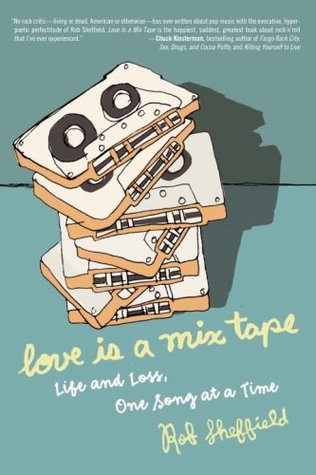
7. Love is a Mix Tape
Have you ever had a night so good, you didn't want to describe it to anyone? Not because you did something illegal or immoral or embarrassing, but because your words could never accurately capture the magic of the real thing? I kind of feel that way about this book. As soon as I read the description, I knew I had to read it; I had no idea how much it would crawl inside my soul and make itself comfortable.
I'm going to jump around here, which is how I talk when I'm excited about something. First, the book: Rob Sheffield, who makes a living writing about music, uses the concept of a mix tape to share his very personal story. He meets the woman who becomes his wife, tells the story of their marriage through music and describes in detail the day she unexpectedly collapses and dies in their home. We meet Renee only through Rob's memories and her track lists and our hearts break along with him. Even if you have never been through a loss like this, it feels entirely relatable. That's because he uses the completely universal concept of music as memory to tell it.
My God, who can't relate to that? We all have those songs. The ones that break us apart or get us back on track. Nothing can transport us quite like the opening strains of a song we used to love. I can't hear the Simon & Garfunkel song "Cecelia" without remembering a ridiculous (and highly dangerous) drinking game my girlfriends and I made up in high school. The first few notes of Barenaked Ladies' "What a Good Boy" take me back to the last night of my freshman year of college when a good friend made me a mix tape for the drive home for summer break. Every Dave Matthews song reminds me of summer and the perfect buzz and the breeze off the Columbia River at the Gorge Ampitheater. There are many more songs that I can't even write about now; the connection between song and emotion and memory are so strong and somehow so fragile, I feel even mentioning them diminishes their meaning. Sheffield writes, "Tonight, I feel like my whole body is made of memories." I feel ya.
Do you have a box of tapes like this? I'm talking to those of you over the age of, say, 32. You young people can stop reading now. A Spotify playlist is NOT a mix tape. A mix CD isn't even a mix tape. Only a mix tape is a mix tape - permanent and full of audio buzz and, if you're really old like me, full of songs you waited to record off the radio so you sometimes hear the last few seconds of a DJ intro. Mix tapes are the whole damn thing.
Don't come at me, young people. I still make iTunes playlists for EVERYTHING, but it's not the same. They're too easy to make and too easy to delete. They're too... dispensable.
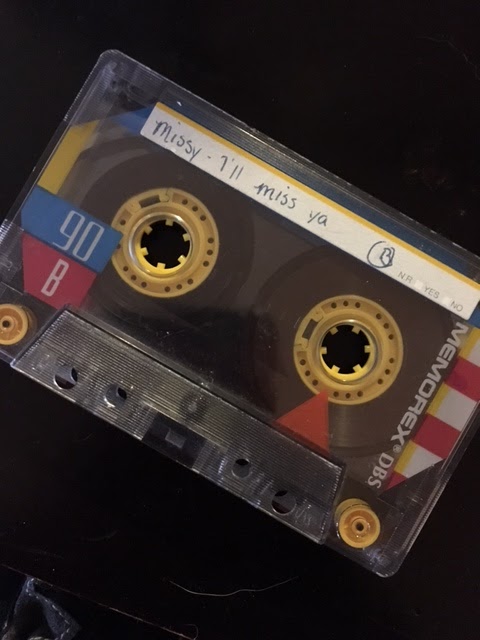
I have a box in my crawl space spanning DECADES, telling the stories of college parties and breakups and road trips. They don't play well anymore, they're all slowed down to about 3/4 speed. But, I won't let them go. The one above is from 1995. I was about to go on a choir trip to Europe and a boy who was a "friend but was more than a friend but was just a friend" made it for me for the trip. He's a smooth guy - was then, still is now. The playlist is full of suggestive R&B tracks that would still get regular rotation today. It has survived more than 21 years and countless moves and I will never get rid of it. Like any good mix tape, it's a moment of time and even seeing the handwriting (and, that people used to call me Missy) brings me back to my pink wallpapered room in my childhood home when he gave it to me. That's a mix tape. It's history, frozen.
That's why this book feels like so much more than just a memoir of loss. Sheffield begins each chapter with a mix tape track list. Somehow, reading the lists makes this already personal story feel even more intimate. He tells their story through the music that served as their soundtrack. I don't know many of the songs, but you feel the flow. I saw myself in the tape on page 180, with the daring mix of Bob Dylan and TLC.
Through the track lists and the chapters between, you watch the tone change from their life before to his life after.
Even if your taste in music isn't the same, you feel the connection. My cheeks hurt from smiling as he describes their wedding almost solely through the music. He describes what they danced to, what moved them, the cheesy reception numbers that got the grandparents out of their seats. I spent more time on the "must play" and "do not play" lists for my wedding reception than I did on the flowers, so this whole section was totally my jam (my "do not play" list was longer than the list of songs to play. Never play Celebration, people. It's beneath you.)
The guy's a music critic, so his taste is way cooler than mine. But, as he moves through the 90's, I was elated to see Kriss Kross, En Vogue and Tag Team, even if only referred to in an ironic way. He also references the long-forgotten Natural Selection one-hit wonder "Do Anything" which dramatically elevated my drive to work this week (it is still, after all these years, "smooth to the groove like sandwich bread.")
The best thing about music and songs and mix tapes is also the worst thing: they always remind you of a time you can't get back. I'll never get ready for a night out with my college friends to the Fugees "The Score." I'll never cruise the boring roads of my home town, singing - loudly - to "Ghetto Superstar." I'll never again bawl my eyes out to the Dixie Chicks' "Heartbreak Town" as I drive across the northwest to a town I've never seen, ready to start my life as a grown-up. The memories will make you smile, but they'll just as quickly break your heart.
That's the ride Sheffield takes you on. Imagine him trying to listen to the songs around which they built their life - after she's gone. Not only does hearing those old songs hurt, he hurts for the songs "she never got to meet." It's sad and beautiful. Grief is not universal; music, regardless of taste, certainly is.
Who should read this book? Anyone who has ever made or received a mix tape. Anyone who's been in love and felt the need to immediately make a tape to say all the things they're not ready to say out loud. Anyone who's had to say goodbye to someone they love with the hope the tape will stay with them and maybe the songs will always remind them of you.
The risk of giving someone a mix tape is that they won't understand it. Even worse, they may not like it. I'd feel less vulnerable writing someone a letter than I would making them a mix tape. That's how I feel about this book. I want you to feel it as deeply as I did. I want you to run to the basement and brush the dust off those boxes of Magnavox cassettes. I want you to hear Toni Braxton's Unbreak My Heart and cry over your college boyfriend. But, if you read it and don't love it, I never want to know.
I'm going to jump around here, which is how I talk when I'm excited about something. First, the book: Rob Sheffield, who makes a living writing about music, uses the concept of a mix tape to share his very personal story. He meets the woman who becomes his wife, tells the story of their marriage through music and describes in detail the day she unexpectedly collapses and dies in their home. We meet Renee only through Rob's memories and her track lists and our hearts break along with him. Even if you have never been through a loss like this, it feels entirely relatable. That's because he uses the completely universal concept of music as memory to tell it.
My God, who can't relate to that? We all have those songs. The ones that break us apart or get us back on track. Nothing can transport us quite like the opening strains of a song we used to love. I can't hear the Simon & Garfunkel song "Cecelia" without remembering a ridiculous (and highly dangerous) drinking game my girlfriends and I made up in high school. The first few notes of Barenaked Ladies' "What a Good Boy" take me back to the last night of my freshman year of college when a good friend made me a mix tape for the drive home for summer break. Every Dave Matthews song reminds me of summer and the perfect buzz and the breeze off the Columbia River at the Gorge Ampitheater. There are many more songs that I can't even write about now; the connection between song and emotion and memory are so strong and somehow so fragile, I feel even mentioning them diminishes their meaning. Sheffield writes, "Tonight, I feel like my whole body is made of memories." I feel ya.
Do you have a box of tapes like this? I'm talking to those of you over the age of, say, 32. You young people can stop reading now. A Spotify playlist is NOT a mix tape. A mix CD isn't even a mix tape. Only a mix tape is a mix tape - permanent and full of audio buzz and, if you're really old like me, full of songs you waited to record off the radio so you sometimes hear the last few seconds of a DJ intro. Mix tapes are the whole damn thing.
Don't come at me, young people. I still make iTunes playlists for EVERYTHING, but it's not the same. They're too easy to make and too easy to delete. They're too... dispensable.
I have a box in my crawl space spanning DECADES, telling the stories of college parties and breakups and road trips. They don't play well anymore, they're all slowed down to about 3/4 speed. But, I won't let them go. The one above is from 1995. I was about to go on a choir trip to Europe and a boy who was a "friend but was more than a friend but was just a friend" made it for me for the trip. He's a smooth guy - was then, still is now. The playlist is full of suggestive R&B tracks that would still get regular rotation today. It has survived more than 21 years and countless moves and I will never get rid of it. Like any good mix tape, it's a moment of time and even seeing the handwriting (and, that people used to call me Missy) brings me back to my pink wallpapered room in my childhood home when he gave it to me. That's a mix tape. It's history, frozen.
That's why this book feels like so much more than just a memoir of loss. Sheffield begins each chapter with a mix tape track list. Somehow, reading the lists makes this already personal story feel even more intimate. He tells their story through the music that served as their soundtrack. I don't know many of the songs, but you feel the flow. I saw myself in the tape on page 180, with the daring mix of Bob Dylan and TLC.
Through the track lists and the chapters between, you watch the tone change from their life before to his life after.
Even if your taste in music isn't the same, you feel the connection. My cheeks hurt from smiling as he describes their wedding almost solely through the music. He describes what they danced to, what moved them, the cheesy reception numbers that got the grandparents out of their seats. I spent more time on the "must play" and "do not play" lists for my wedding reception than I did on the flowers, so this whole section was totally my jam (my "do not play" list was longer than the list of songs to play. Never play Celebration, people. It's beneath you.)
The guy's a music critic, so his taste is way cooler than mine. But, as he moves through the 90's, I was elated to see Kriss Kross, En Vogue and Tag Team, even if only referred to in an ironic way. He also references the long-forgotten Natural Selection one-hit wonder "Do Anything" which dramatically elevated my drive to work this week (it is still, after all these years, "smooth to the groove like sandwich bread.")
The best thing about music and songs and mix tapes is also the worst thing: they always remind you of a time you can't get back. I'll never get ready for a night out with my college friends to the Fugees "The Score." I'll never cruise the boring roads of my home town, singing - loudly - to "Ghetto Superstar." I'll never again bawl my eyes out to the Dixie Chicks' "Heartbreak Town" as I drive across the northwest to a town I've never seen, ready to start my life as a grown-up. The memories will make you smile, but they'll just as quickly break your heart.
That's the ride Sheffield takes you on. Imagine him trying to listen to the songs around which they built their life - after she's gone. Not only does hearing those old songs hurt, he hurts for the songs "she never got to meet." It's sad and beautiful. Grief is not universal; music, regardless of taste, certainly is.
Who should read this book? Anyone who has ever made or received a mix tape. Anyone who's been in love and felt the need to immediately make a tape to say all the things they're not ready to say out loud. Anyone who's had to say goodbye to someone they love with the hope the tape will stay with them and maybe the songs will always remind them of you.
The risk of giving someone a mix tape is that they won't understand it. Even worse, they may not like it. I'd feel less vulnerable writing someone a letter than I would making them a mix tape. That's how I feel about this book. I want you to feel it as deeply as I did. I want you to run to the basement and brush the dust off those boxes of Magnavox cassettes. I want you to hear Toni Braxton's Unbreak My Heart and cry over your college boyfriend. But, if you read it and don't love it, I never want to know.
Subscribe to:
Posts (Atom)