Sunday, March 24, 2019
My Ex-Life
"4 Stars!"
"A ton of fun!"
"Utterly refreshing!"
Those aren't my reviews, but other reviews left on Good Reads of this book that I first found out about through the NPR Book Concierge.
My review:
"Meh."
And it wasn't just "meh" - it was 336 pages of meh. And, it started really strong, so my hopes were high. In the end, it just felt like too many interesting story lines and a plot that had promise, but the whole thing just really fell flat.
My Ex-Life is about a formerly married couple who split for pretty obvious reasons. For one, they lost a baby before it was born. Also, he's gay. But, circumstances in their lives decades later had them reaching out to each other. You kind of know where it's going all along, yet that isn't really what bothered me. What bothered me is that the very interesting subplots (his work as a college admissions specialist, working with his ex-wife's daughter; the daughter getting caught up in teenage drama, etc.) were never given the chance to develop into something worthwhile.
I felt myself SLOGGING through this thing. The writing was snappy and interesting, but the book could have been more interesting if it was about 150 pages shorter. And just when you think it was coming to its natural end, the author throws in an insane twist with the daughter that's more annoying and improperly handled than the rest of the book.
You can trust me on this (I gave it 2 stars) or the others who have reviewed it who gave it a strong 4 stars... For me, I just don't see this being an enjoyable journey for any reader.
Sunday, March 10, 2019
The Incendiaries
"I drank more... I barely slept; I wanted every prize."
A book plot in a sentence, you'd think after reading the first few chapters of The Incendiaries. You feel like you're reading something more akin to Gatsby than a novel about belief and longing and a dangerous cult. But, for me, that's what made this such a fascinating, compelling novel. A slow burn that builds, hits its climax with remarkable subtlety, then nestles inside your bones after it's complete.
It feels at first like a typical college novel. People finding themselves, searching in others, looking for a meaning beyond what they had before. The novel focuses on a Korean-American student who was on track for greatness when tragedy changed her course. You know right away that Phoebe is chasing meaning in places that won't fulfill her - elaborate parties, bottles of liquor, late nights. Then, you watch through her boyfriend's eyes as she tumbles towards even greater tragedy, following a charismatic man with a questionable past towards an ending only she can't see coming.
Her boyfriend, Will, is searching for meaning, too. A one-time missionary who loses his faith - only to watch the woman he loves searching so desperately to find it. He's longing for her, she's longing for something else. And, they both make terrible mistakes in their quest.
This is a compact and complex novel with flawed characters, language that doesn't necessarily fit them and incongruous imagery of how most of us experienced our college years. Yet, it works.
And that slow burn? It heats up throughout, always leading you believe the whole thing is about to blow. When it does, quite literally, the author never strays from the simplicity with which she tells the rest of the story. The story itself is a roller coaster; the book, though, is steady and powerful.
This was a quick read. It took me just a couple of days and it kept me coming back for more. It's getting a ton of hype and it's worthy of that. Simple and powerful. Just enough to make it great.
Monday, March 4, 2019
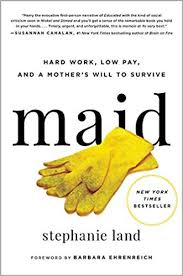
Maid
I think what you would call this is a failure to connect.
I really wanted to like this book. To be moved by it. And, while the subject matter was certainly worthy of such a connection, such a stirring of emotion, the story itself simply fell flat.
Stephanie Land's journey is certainly compelling. A single mom, struggling to escape the cycle of poverty while raising her daughter in the shadows in western Washington. She cleans homes to make ends meet, all the while dreaming of the life she could lead. The people whose homes she cleans barely know her name - most have never seen her face - yet she finds herself learning of them through the patterns of their lives they unintentionally leave behind. She spends long days scrubbing, cleaning other people's messes, while unable to crawl out from a financial hole. She's somehow hopeful - and, in the end, prevails.
Seems compelling enough, right? And, people have likened this story to the one told in Educated. But, for me, it never got that deep. I can't even explain why. I never felt hopeful for her, I never felt despair. I just never really felt at all. The stories of frustration she told were clearly worth connecting to; hers is one of failed relationships, lack of family support and a frustrating system of state assistance. But, I didn't feel - and, I didn't learn anything about what can be done for others to overcome what is an unfortunately common story.
Monday, February 18, 2019
Brave Not Perfect
I was late to work because of this book. And I wasn't even reading it yet.
A couple of weeks ago, I had just dropped off my kids and was driving to work. That 25 minutes or so usually sets the tone for my whole day. If I need to get fired up, I hook up my Apple Music and jam - loudly. If things are feeling even-keeled, I'll turn on NPR and zone a little. That's what I was doing when Reshma Saujani burst into my life.
She did it politely, of course. She was a guest on On Point Radio and I heard her talking about how women are taught as girls to strive for perfection - and, how that effort leads us to take fewer risks than men. That fact often leaves women underpaid, overly stressed and unable to find joy in what we're doing. It gets us stuck.
I was so intrigued by what she said, I pulled into the nearest parking lot to pre-order her book, which happened to come out the next day. (That took 10 seconds on Amazon, but the parking lot happened to be a Starbucks and I thought it was a sign I needed to get coffee. So, I guess it wasn't exactly the book's fault I was late.)
Her topic spoke so clearly to me, I couldn't wait to get the book and dive in. And, when I did, I found myself nodding throughout.
Apparently, I could have skipped the book and went right to her Ted Talk on the same subject, but I'm so glad I didn't. Reading the book over the course of the past week caused me to really think differently about the expectations I have for myself, the risks I take (and don't take) and how speaking up and taking risks may lead to people being uncomfortable - but maybe that's the exact reason I need to do more of it.
She begins the book with a dedication "to every 'perfect' girl and woman; you are braver than you know."
It doesn't always feel like it, though, does it?
I probably needed this book more in my 30's. At that time in my life, I cared so much about what people thought of me, what people thought I should do and if I was living my life in a way that would be without great risk or loss. What a wuss! Now, I feel so much more comfortable with the space I occupy. Still, this book spoke deeply to the part of me that still believes perfection is the ultimate goal. As someone who manages a staff of 30+ people who happen to be confident, hard-working and smart, I often question my role in speaking candidly of my expectations of them. Will they still like me? Will they roll their eyes? Will they talk about me at the bar after work?
I realize that yes, they will talk. And, that's okay. But, I also believe that they'll respect having a boss that makes decisions and stands by them. And, someday - when they're bosses - they'll understand the risks I have to take every day in an effort to do the right thing by them and by our employer.
In the book, Saujani relates her own failures and the risks she's taken because of them. She took a very public loss in a run for Congress and turned it into a non-profit that is literally changing how women will operate in tech in future generations. She didn't know anything about running a non-profit or coding - and, started the non-profit Girls Who Code. She took a massive risk, right after a massive failure; through that, she broke through and grew in ways she never expected.
The book recounts stories of highly successful women who are scared to take risks and are often hiding unhappiness just below the well-manicured surface. Many women will relate to those stories, many will find solace. But, she does more than relay the stories and the science behind why women are this way. She also provides a toolkit for embracing that bravery, even if it's only one small step at a time.
She talks about we teach our sons to climb to the highest rung on the monkey bars, while constantly reminding our girls to "be careful." We teach little girls to be sweet and quiet, while we let boys explore their outer voice and get down in the mud (I have sons, I see this difference every day.) She talks about seeking out feedback - especially negative feedback - as the only true way to grow. About how men apply for jobs even if they only meet 60% of the qualifications, while women wait until they match 100%. And, what stroke the deepest chord with me, about being okay knowing that not everyone is going to get you.
Overall, I found this book to be enlightening and empowering. I believe it could have the greatest benefit for young women who are starting to stand in their own spotlight. It teaches us that being perfect is bullshit; being brave is the ultimate key to happiness and success.

Saturday, February 9, 2019
The Good Neighbor: The Life and Work of Fred Rogers
I think for every one of us, there's at least one thing. One thing that brings a wave of nostalgia so powerful and consuming, it cracks your heart wide open. There are quite a few of those things that do that for me - one of the most powerful is the life and work of Mr. Rogers.
I'm a child of the 80's. I spent my earliest years with very few channels on the TV. PBS, of course, was one - and, Mr. Rogers and Sesame Street were an integral part of my early childhood. For me - and, for so many people around my age and a little older/younger - this man and his show were part of our every day. I can close my eyes and remember so vividly his trip to the Crayon factory, the tinkly music of the trolley and the familiar door knock of Mr. McFeely with a special delivery. I still say I'm "Mr. Rogers-ing my shoes" every time I change from one pair of shoes to another. This man and his work are woven into the fabric of my DNA and I worried that reading this book would turn me into a puddle of tears.
It did. But, it was worth it.
(tears.)
This book is a complete biography of the man we thought we knew. Or maybe we never really needed to know him as kids, we just needed to trust him. Either way, it begins with a privileged childhood in an upscale Pittsburgh suburb. Fred Rogers' parents were incredibly wealthy, his mother doted on him, as he was the only child for many years. But, he was lonely, too - and, often sick. Elementary school bullies once chased him home, calling him "Fat Freddy." Fred was loved, but not often encouraged to share his feelings. That was a memory that drove him later to teach children that their feelings are to be talked about and embraced.
You learn so much in this book about his college years, his time in the seminary, his work as an accomplished musician and what kind of dad he was to his two sons at home. You learn, too, about early television and how slapstick was the normal fare for kids. Rogers insisted that this powerful new tool could be used for good - for the education of children in their formative years. And, throughout decades of change in that medium, he held fast to his principles: that he wouldn't allow advertising, that he wouldn't allow the marketing of merchandise from the show and that he would always think about how children would receive the messages they saw on screen. It's remarkable that he never caved to the pressures of the times. He was loyal and respectful to the children he was proud to serve, almost to a fault.
You learn quirks of Mr. Rogers in this book an fascinating details about the man himself. He weighed 143 pounds every day of his adult life. He and his wife once caught their sons growing pot in the family basement. He never learned to put in/take out his contacts, so when he wore them for the show, someone had to do that for him. That he used the voices of his puppets in adult conversations when he was trying to express a different side of his personality (King Friday often disciplined the children at the dinner table.) You also learn that, to a person, people say Fred Rogers was exactly the man he portrayed on TV. Forget the rumors that he was a Navy SEAL (that was really a thing??) He was a kind, gentle, driven soul who dedicated his life to helping children.
He was vulnerable, too. In his last days, Rogers worried he hadn't done enough to be accepted into the kingdom of heaven. Imagine that. Mr. Rogers wondered if he was worthy.
Towards the end of the book, a friend described Rogers as being quiet and reserved, but also the most powerful person he'd ever met. Powerful in his resolve not to waiver from his original mission.
Millions of grown-up kids like me are better for it.
Mr. Rogers is super hot right now, as the kids would say (they wouldn't - but Mr. Mugatu from Zoolander would.) In addition to this book, there's a movie coming out with Tom Hanks in the title roll. There's also a fascinating documentary that touches on a lot of what is explored more deeply in this book. I hesitated to watch that doc in the theater, as I didn't want my sobbing and sniffling to interrupt the other patrons. Instead, I stupidly watched it on a recent flight. I was left with tears streaming down my face right there in 22E.
There's a moment referenced in the book that broke me in the documentary. His friends recall a moment in a commencement speech where Mr. Rogers asks the audience to take one minute and think about a person who has helped them in their life. The documentary cameras flash to multiple people, welling up with tears as they think of that person. I'm welling up again thinking about it now.
You have to imagine that, for so many, its Rogers' own face that comes to mind.
Thursday, January 31, 2019
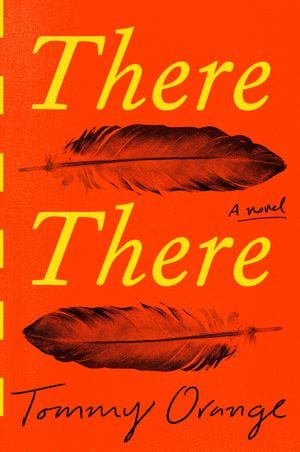
There There
Sometimes a book gets so much hype - too much hype - that there's no way it could ever live up to the reviews and critical acclaim. Sometimes, though, it's just that good. There There is a book for the ages.
(Damn, I sounded like Aristotle or something for a second there...)
Really, though, all that hype was for good reason and they'll be teaching this book in high school and college English classes for years to come.
The fact that it's Tommy Orange's first freaking book? That's not even fair.
There There is a book that combines the stories of what Orange calls "Urban Indians" - Native Americans living in or stemming from Oakland, California. It's about what it means to be an Indian in a place where there's nothing to connect you to your heritage. It's about what ties us all together, even when no clear string remains. It's about the good, the bad and the violent realities in so many lives.
And, it's told in incredible prose.
It's hard to tell you plot here, because it really tells character stories by chapter. We meet, we move on, we revisit, we revise. It all comes together in explosive fashion but, for me, it was really more about the journeys they took to get there and the way Orange can take your breath away with a sentence so complex, yet so simple, you don't see it coming.
If there's a con in this great novel, it's a small one. Orange tells so many people's stories, you almost need a chart to keep them straight. But, the way he advances each narrative makes all of that worth a page or two of confusion every few chapters.
Look, I'm not going to say anything more profound than the critics have said about this incredible book. It was on nearly every "great book of 2018" list. I will say that it's accessible, meaningful and thick enough to stick to your ribs. And also deep enough to break your heart.
Little Fires Everywhere
I hate how long it's been since I read this book and I'm just now sitting down to right about it. I read this weeks ago. But, as the title suggests, life is about little fires. And, so far in 2019, they're everywhere.
This book has been on my list for a long time, as someone told me it's a "must read." Someone else described it as a "teen version of Big Little Lies." What it was for me, ultimately, was a story about those who choose to suppress their deepest desires and those who choose to let it all burn in order to feed that voice inside.
The book begins in the same place where it ends, with a family's home burning to the ground. Instantly, the author reveals the most likely arsonist. She happens to be the teenage girl who lives inside. While the pages in between describe what led up to that moment, it ultimately brings you back to the same conclusion. What you learn along the way is motive - not just of the fire starter, but also of two families with very different reasons for why they've ended up where they are.
This book tells complex stories about families, choices, passion, decisions and what holds us back from following the path we most desire. It's also about the way we choose to judge others for making the choices we're not brave enough to make. It's about mothers and daughters, too, and the complex relationships between the two.
Someone told me this book was too slow for their taste. I didn't feel that. While I wasn't dying to get to the next page, I was enthralled enough with the characters that it kept me interested. On Good Reads, I gave it 4 stars, but 3.75 is probably more accurate. It's more of a slow burn than an inferno.
Subscribe to:
Posts (Atom)